
Age Gating vs. Age Verification: Why Websites Must Do More to Protect Minors
EarthID | April 2025
The digital world is full of content that isn’t meant for children, yet every day, minors can easily access age-restricted platforms with just a click. Whether it’s alcohol, gaming, or adult content, the need to protect young users online is growing urgent. Most websites still rely on a basic method called age gating, popups that ask users to enter their birthdate or confirm they are over a certain age. But in 2025, that simply isn’t enough. Global regulations are catching up. From the UK’s Online Safety Act to the EU Digital Services Act, the message is clear: websites must move from guesswork to accountable, privacy-conscious age verification. And that’s where EarthID steps in.
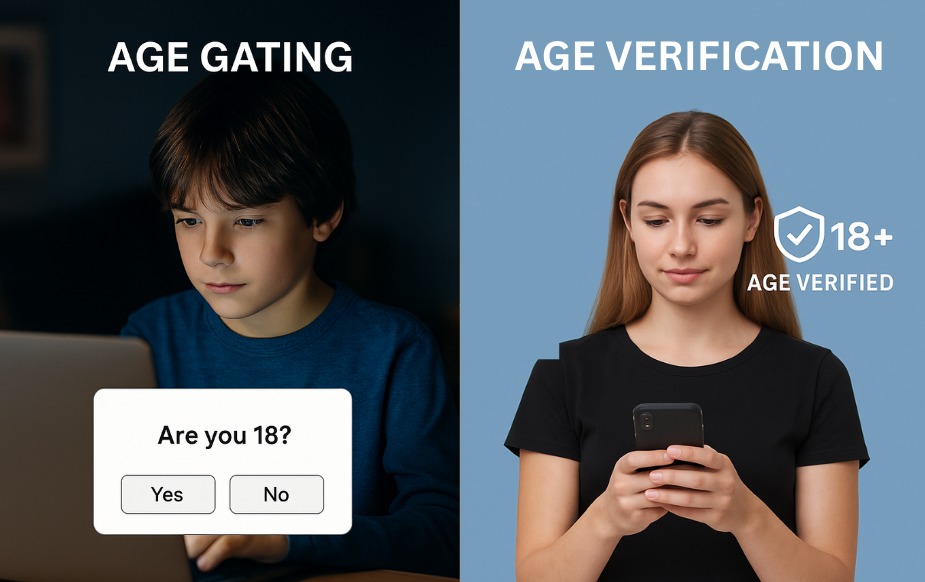
What is Age Gating? Age gating is the online equivalent of a doorman asking, “Are you over 18?”, and taking your word for it. It usually takes the form of: * A pop-up asking for a birthdate * A checkbox saying "Yes, I’m over 18" That might work as a reminder, but it's easy to bypass. Anyone, of any age, can simply click through. There’s no real check.
The Problem with Age Gating Age gating gives the illusion of action, but in reality, it does very little. It may satisfy an outdated checklist, but it doesn’t actually keep underage users out. And both regulators and the public are increasingly calling it out for what it is: insufficient. Here’s why age gating falls dangerously short: * No actual verification: Minors can easily enter a false birthdate or click "Yes, I'm over 18" with no consequences. It relies entirely on honesty, which defeats the purpose. * Fails legal thresholds: Global regulations are moving toward proof-based standards. Without genuine age verification, platforms risk non-compliance and steep penalties. * Erodes trust: Parents, regulators, and users expect meaningful protection. A superficial gate signals that your platform isn’t serious about safeguarding young users. * Creates false security: It may help you look compliant, but it doesn’t make you compliant—and certainly doesn’t prevent harm. In short: age gating is not protection, it’s box-ticking. And in today’s digital landscape, that’s not just inadequate, it’s risky.
What is Age Verification? Age verification means actually confirming someone’s age, not just asking. This may be done through means such as: * Scanning a valid government-issued ID (e.g., passport, driving licence) to confirm date of birth * Facial matching to ensure the person presenting the ID is the rightful owner But effective age verification isn’t just about identity documents or biometrics. The most advanced solutions, like those offered by EarthID, now enable users to prove their age without revealing personal information, using privacy-enhancing techniques that ensure no sensitive data is shared or stored. This means businesses can meet strict regulatory standards without over-collecting data while ensuring Minors are kept out of age-restricted spaces.
Why Regulators Are Taking Action (And Why You Should Care) Governments around the world are no longer turning a blind eye to weak protections for minors. "Good enough" isn't good enough anymore. The expectation is clear: platforms must take real, measurable steps to keep underage users away from inappropriate or harmful content. Here’s what that looks like in practice: * UK Online Safety Act: This law gives regulators the power to fine companies up to £18 million or 10% of global turnover, whichever is higher, if they fail to prevent children from accessing harmful content. That includes not using effective age verification tools. * EU Digital Services Act (DSA): Platforms that don’t comply with their duty to assess and mitigate risks to minors can face fines of up to 6% of their global annual revenue. The DSA also allows the EU to demand immediate corrective action, including the removal of non-compliant services. * COPPA (US): Under the Children’s Online Privacy Protection Act, companies can face fines of up to $50,120 per violation, per child. And enforcement is ramping up, with high-profile settlements already sending a clear message: regulators are watching.
How EarthID Helps EarthID offers a frictionless and privacy-respecting way to verify age. Instead of asking users to trust your site, we empower them to prove what’s needed, without oversharing. * Users prove they meet the age requirement, nothing more * No personal data is stored or shared * Works across websites and platforms * Quick to implement and simple for users Whether you’re running a streaming service, an online marketplace, or a gaming platform, EarthID helps you protect minors without creating friction or data risks. Putting up a gate isn’t the same as locking the door. If your platform serves age-restricted content or services, now is the time to stop relying on outdated tactics and start using solutions that actually work. Not just to stay compliant, but to lead with responsibility. You can protect minors without invading privacy. You can be compliant without collecting or storing personal data. And you can build trust by showing users and regulators alike that your platform takes safety seriously. With EarthID, you protect minors, earn user trust, and stay ahead of the law, while keeping privacy at the heart of your approach.